


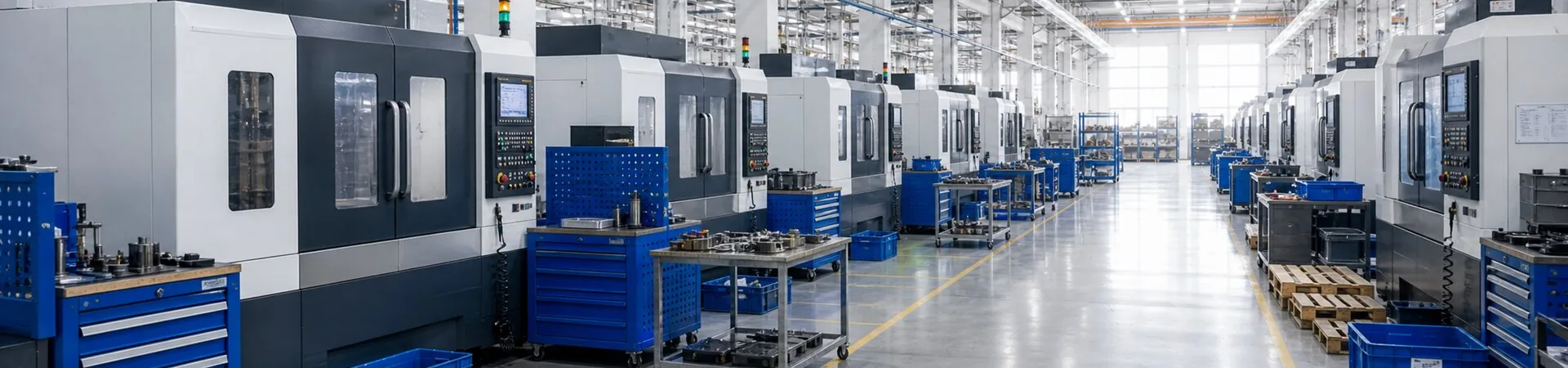
New automation and data integration capabilities are reshaping how industrial buyers source custom CNC machined parts, from precision turned components to high-volume fasteners.
CHICAGO – April 26, 2026 – As smart manufacturing systems become the backbone of modern production floors, industrial buyers face a critical shift in how they procure precision hardware. The move toward connected, data-driven factories demands not only tighter tolerances but also unprecedented supply chain visibility for components like bushings, pins, shafts, and insert nuts.
01. Rising need for OEM precision parts in automated lines

Automated assembly lines in automotive and electronics sectors rely on thousands of custom precision parts per shift. When a high-speed pick-and-place machine fails due to an undersized locating pin or a worn industrial bushing, the entire smart system can halt. Engineers now specify stainless steel bushings and precision ground shafts with dimensional data that feeds directly into their manufacturing execution systems, allowing predictive maintenance and real‑time quality tracking. This integration forces suppliers to move beyond traditional inspection reports and deliver component-level twins for every custom turned part.
02. How smart systems drive tighter specs for custom hardware
Smart manufacturing systems continuously collect process data, which exposes even micron-level deviations in precision machined components. For example, a brass press-fit nut that varies by just 0.02mm can cause inconsistent torque in an automated driver, triggering rejection in downstream vision systems. To meet these demands, leading CNC turning services now equip multi-axis lathes with in-process gauging and adaptive tooling. The result is consistent production of high precision custom fasteners, including copper insert nuts and custom copper parts, with Cpk values above 1.33 – a baseline requirement for Tier‑1 automotive and medical device suppliers.

03. Custom fasteners for plastic injection molding gain new role
One often overlooked application is the integration of custom fasteners for plastic injection molding. Press-fit nuts and brass insert nuts are molded directly into housings for consumer electronics and automation controllers. In a smart manufacturing environment, the molding press communicates with the parts feeder to verify each insert's position and temperature profile. Suppliers that master this synergy produce automotive fasteners and custom precision sleeves that eliminate secondary operations. This reduces assembly time by up to 30% while ensuring that self-lubricating bronze bushings or precision turned parts never shift inside the mold cavity.
04. High-volume production of custom hardware meets Industry 4.0
Scaling from prototypes to high-volume production of custom hardware used to create quality divergence. Smart systems now enable identical repeatability across thousands of precision machined parts. By networking CNC lathes and grinding cells to a central digital thread, manufacturers can produce custom locating pins and stainless steel fasteners with traceability from raw coil to finished component. Automated optical sorting, combined with RFID-tagged totes, ensures that only components meeting all SPC limits reach the assembly line. For industrial buyers, this means fewer surprises and lower total cost of ownership – a direct benefit of aligning custom hardware manufacturing with smart factory principles.
“Smart manufacturing systems are no longer just about machines talking to machines,” said a senior production engineer at a Midwest automation integrator. “They require every custom CNC machined part – whether a bushing, a shaft, or a copper insert nut – to carry data. Suppliers who embed quality into the digital thread will lead the next five years of industrial sourcing.”
As production intelligence matures, procurement managers face a pivotal question: Is your current supplier of precision turned parts and OEM precision hardware ready to deliver not just components, but verified, data‑rich assets for your smart manufacturing systems?